The V60, the Chemex, and the AeroPress are three manual coffee makers: the V60 is a cone-shaped dripper, the Chemex is a glass carafe with a filter that brews several cups, and the AeroPress is a chamber where the coffee is pressed through with air.
According to HARIO, the maker of the V60, every brew should take less than 3 minutes, no matter how many cups you make (HARIO, V60).
You walked into a coffee shop and spotted a white ceramic cone, a glass carafe with a wooden collar, and a tube that looks like a giant syringe. And you wondered which one is right for you. Good question. All three make delicious coffee, but each one has its own personality, its own pace, and its own quirks.
In this guide, we compare the V60, the Chemex, and the AeroPress using the official instructions from their makers. You’ll see what each one is and how to use it step by step. You’ll also learn which filter, grind, and ratio each one calls for, which one makes sense if you’re just starting out, and which coffee shines in each method. No fuss: just enough to choose well and make your first cup taste great.
What is a V60 and how do you use it?
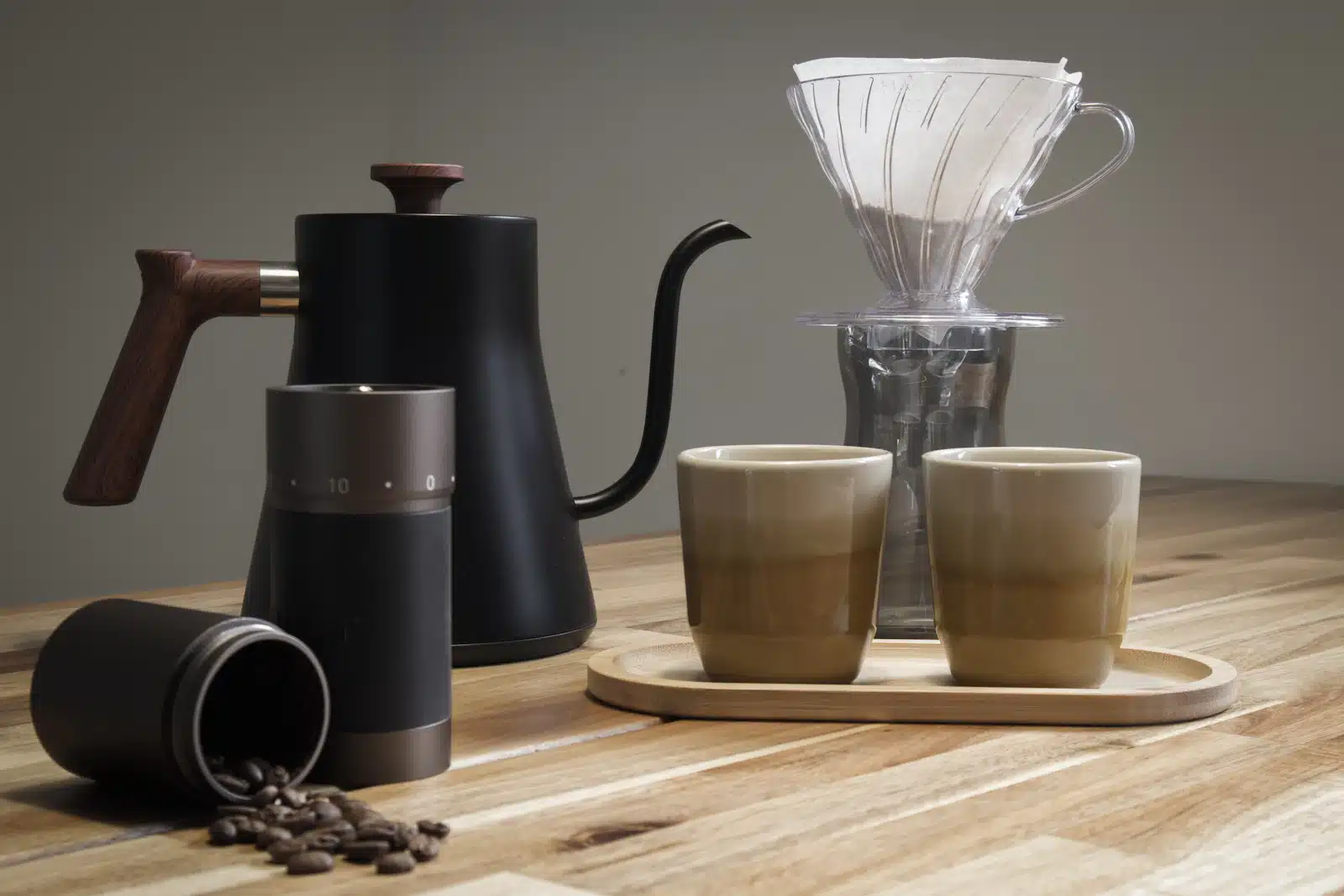
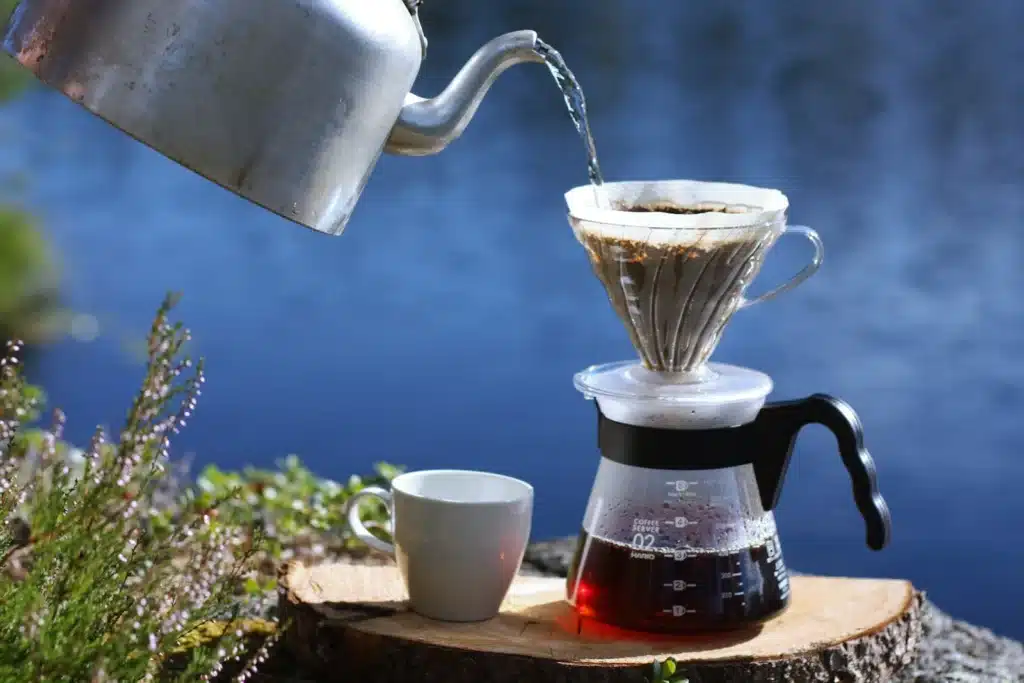
The V60 is a cone-shaped dripper made by HARIO: you put ground coffee in a paper filter and pour hot water over it by hand, and the coffee drips into your cup by gravity. Its name comes from its V shape and its 60-degree angle. It makes a clean, aromatic cup, perfect for picking up the tasting notes of each origin.
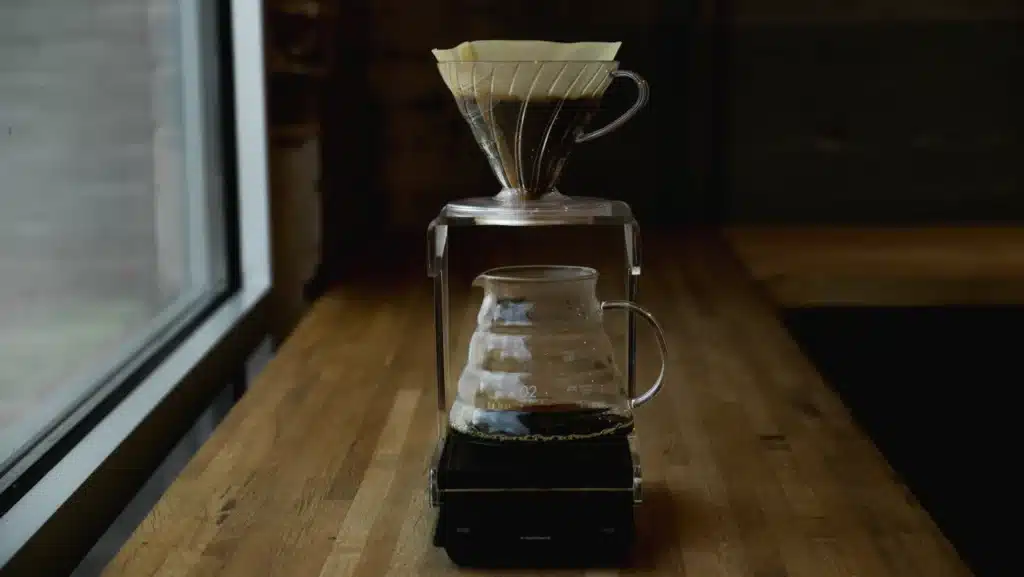
HARIO suggests this basic recipe on its official website:
- Set up the dripper. Fold the seam of the paper filter, fit it snugly inside the cone, and place the dripper on top of your server or mug.
- Add the coffee. Add the ground coffee and shake gently to level the surface.
- Bloom the coffee. Slowly pour twice as much water as coffee, starting from the center, until all the grounds are wet. Wait 30 seconds. You’ll see the coffee puff up and release gas.
- Pour in three stages. Each pour uses four times the weight of the coffee in water. Pour in a spiral from the center out, and avoid pouring directly onto the paper.
- Watch the time. The whole brew should finish in under 3 minutes, no matter how many cups you make. It’s ready when the water stops dripping.
Here’s the beauty, and the challenge, of the V60: HARIO explains that pouring fast gives you a lighter cup, while pouring slowly gives you a more intense one. That means you can tweak the flavor with your pouring hand without changing the recipe.
The V60 isn’t alone in the world of pour-over coffee. Its glass cousin has a different personality.
What is a Chemex and how is it different from a V60?
The Chemex is an hourglass-shaped glass carafe that works as both a dripper and a serving carafe, with its own filter that you fold into a cone. Compared with the V60, it calls for a coarser grind, brews several cups at once, and makes an even lighter, cleaner coffee.
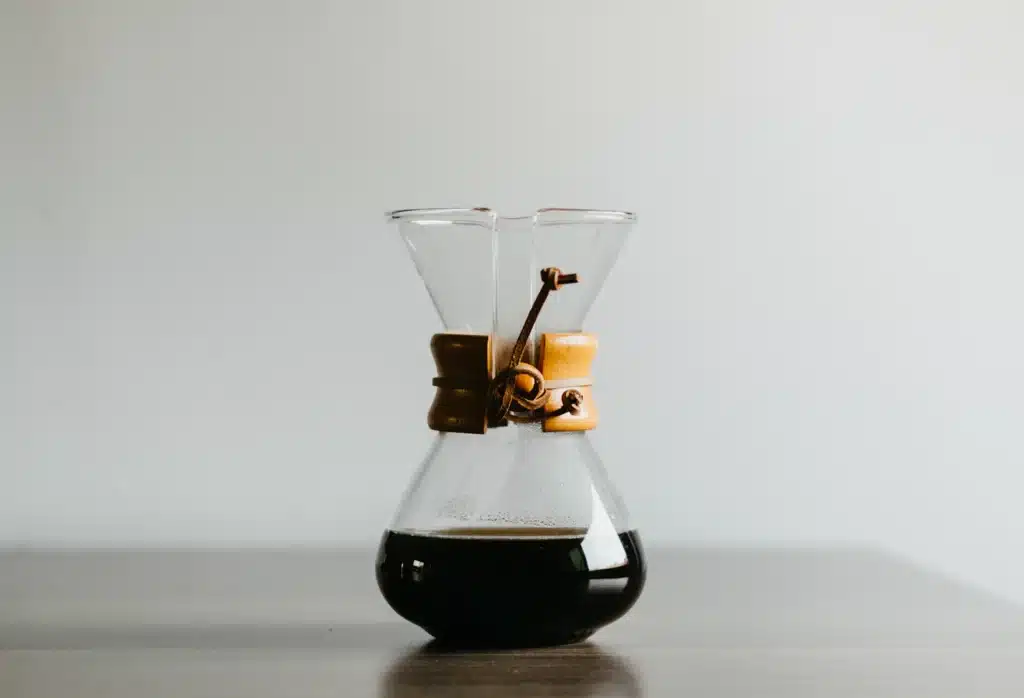
Here’s how its maker uses it:
- Grind medium-coarse. Chemex calls for a medium-coarse grind, a little coarser than for the V60.
- Insert the filter. Open it into a cone so that one side has three layers. That thick side goes against the spout of the carafe.
- Measure the coffee. Use one rounded tablespoon of ground coffee per 5-ounce cup, about 150 ml. If you like it stronger, add a little more.
- Heat the water. Bring it to a boil, take it off the heat, and wait until it stops boiling hard.
- Let it bloom. Wet the grounds with a small splash poured in circles and wait about 30 seconds.
- Pour slowly. Add the rest of the water in several pours, without rushing, until you reach the number of cups you want.
How it differs from the V60, in a nutshell:
- How many people: the Chemex is ideal for sharing. The V60 shines with one or two cups.
- All in one: with the Chemex, the coffee drips into the same carafe you serve from. The V60 needs a mug or server underneath.
- Filter: Chemex uses its own filters, which, according to the brand, hold back oils and sediment that other filters let through.
- Material: the carafe is made of borosilicate glass, the same type used in laboratories, according to Chemex.
Two drip coffee makers, two styles. The third one plays by different rules.
What is an AeroPress?
The AeroPress is a handheld coffee maker shaped like a big syringe: the coffee steeps in water inside a chamber, and then you push it through a paper filter with a plunger. It combines immersion and pressure. It’s compact, cleans up fast, and travels happily in a suitcase or an office desk drawer.
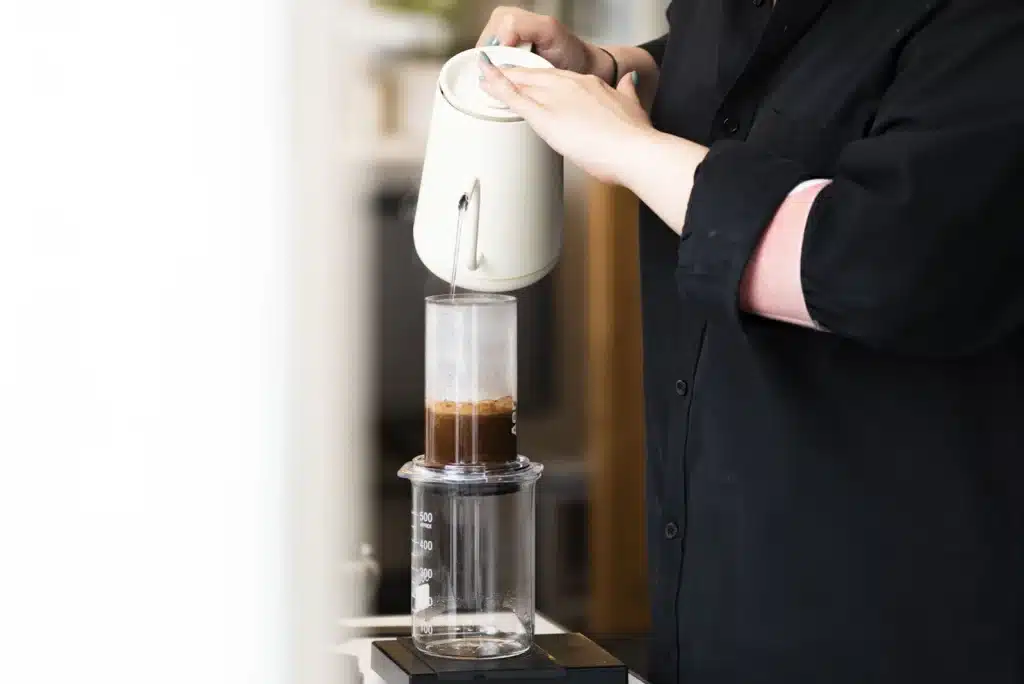
This is the step-by-step method AeroPress gives in its instructions:
- Heat the water to 85 °C (185 °F). If you don’t have a temperature-control kettle, the maker says you can use boiling water.
- Assemble the chamber. Put the paper filter in the cap, screw it onto the chamber, and set it on a sturdy mug.
- Add the coffee. Add 16 to 18 grams of medium-fine ground coffee and shake gently to level it.
- Add the water. Fill up to the number 4 on the chamber. It’s normal for a few drops to fall into the mug.
- Stir. Stir gently for about 3 seconds.
- Stop the drip and wait. Insert the plunger slightly into the chamber and pull it up a touch to create a vacuum. Wait 30 seconds.
- Press. Push down with gentle, steady pressure, without forcing it, until you hear a hiss that starts and then stops. That’s when it’s ready.
You end up with an intense, well-rounded cup. If it’s too strong for you, add a little hot water at the end. That’s not cheating: it’s adjusting to your taste.
Now you’ve met all three. Next, the million-dollar question: which one should you start with?
Which one is best for beginners?
If you’re just starting out, the AeroPress is the easiest to master: it has few steps, doesn’t require any pouring technique, and forgives small mistakes. The V60 is the best school for learning about extraction, but it takes more practice. The Chemex is ideal once you know what you like and you’re brewing for several people at once.
Think about what your mornings look like, and choose:
- Choose the AeroPress if you want good results from day one, you brew one cup at a time, or you’re always on the move between home, the office, and travel.
- Choose the V60 if you enjoy the ritual, you want to understand how your pouring changes the flavor, and you love delicate coffees.
- Choose the Chemex if you usually brew for two or more, you like very clean cups, and you want a beautiful coffee maker to serve from at the table.
Whichever you pick, two things will help you more than any coffee maker:
- A kitchen scale. It lets you repeat the recipe you liked. With the V60, it’s practically a must, because HARIO’s recipe is based on the weight of the coffee.
- Fresh, well-ground coffee. An even grind gives you an even extraction. If the grind is uneven, some of the coffee over-extracts and some of it under-extracts.
If you’re still torn between pour-over and other styles, like the French press or the moka pot, check out our guide to coffee brewing methods. There, we compare every home brewing method.
Once you’ve picked your coffee maker, it’s time to dial in the details: filter, grind, and amounts.
What filter, grind, and ratio does each one use?
The V60 uses a cone-shaped paper filter and a medium grind; the Chemex uses its own filter and a medium-coarse grind; and the AeroPress uses a round paper filter and a medium-fine grind. The ratios also vary, because each maker suggests its own recipe. This table brings together what the official sources say, cited at the end of the article.
| Feature | V60 | Chemex | AeroPress |
|---|---|---|---|
| Brewing method | Manual pour-over | Manual pour-over | Immersion and pressure |
| Filter | Paper cone | Chemex filter folded into a cone, with three layers toward the spout | Round paper filter in the cap |
| Grind | Medium | Medium-coarse | Medium-fine |
| Dose | 18–24 g for 300–400 mL (Pete Licata’s recipe for HARIO) | 1 rounded tablespoon per 5 oz cup | 16–18 g with water up to the number 4 |
| Water | 97 °C / 207 °F (Pete Licata’s recipe for HARIO) | Just off the boil, once it stops boiling hard | 85 °C / 185 °F, or boiling if you don’t have a thermometer |
| Bloom | Twice as much water as coffee, 30 s | A small splash, about 30 s | Stir for about 3 s and steep for 30 s |
| Time | Under 3 minutes | Slow pours after the bloom | Short steep and press |
| Cup profile | Clean and aromatic | Very clean and light | Intense and well-rounded |
| Best for | Anyone who wants to learn and pick up tasting notes | Anyone brewing for several people | Beginners and travelers |
A few notes on reading the table:
- V60 grind: the National Coffee Association (NCA) puts filter methods at a medium grind, similar to kosher salt.
- V60 ratio: in HARIO’s basic recipe, the bloom uses twice the weight of the coffee, and each of the three pours uses four times that weight. With 20 g of coffee, that’s 40 g of water to start and three pours of 80 g. In total, 280 g of water.
- Pete Licata’s recipe: this is the one HARIO publishes for its Drip-Assist accessory. It’s a useful reference for dose and temperature with the V60.
If you buy pre-ground coffee, ask for the grind that matches the method you use most. If you have a grinder, even better: grind right before brewing. In our guide to whole bean vs. ground coffee, we explain when each option makes sense.
With the technique down, there’s just the main ingredient left: the coffee you put in the filter.
Which coffee tastes best in each method?
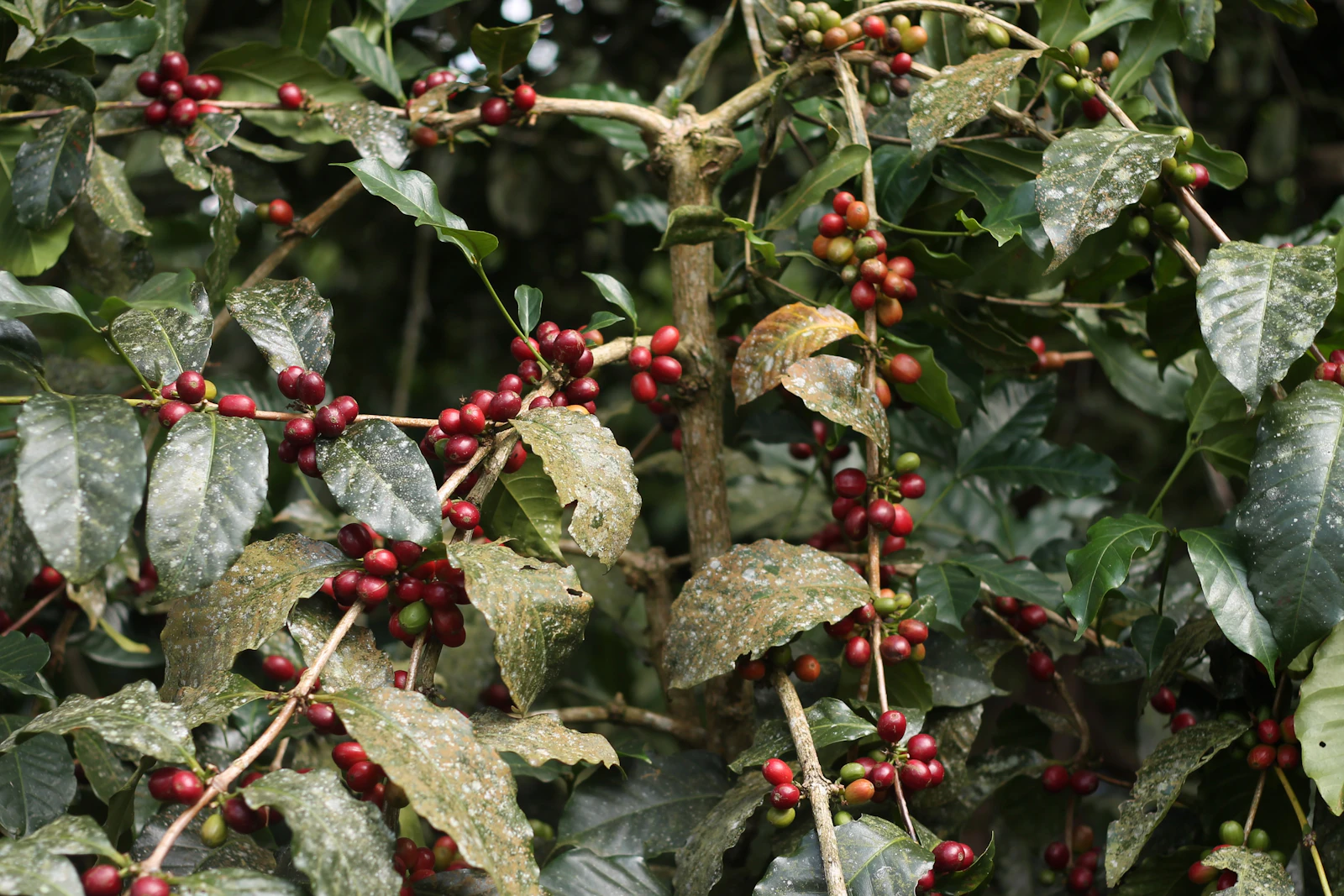
Washed coffees, clean and balanced, shine in the V60 and the Chemex; natural coffees, fruitier and more intense, really stand out in the AeroPress. It’s not a rule, it’s a starting point. Filter methods let you taste each note on its own, while the AeroPress brings body and sweetness together in a more concentrated cup.
Here’s how you can pair them:
- V60: a washed coffee shows off its acidity and origin notes clearly. Our Sonsón washed coffee is clean and balanced, exactly what this dripper does best.
- Chemex: it also pairs really well with washed coffees. Since you’re brewing several cups, choose a coffee everyone at the table will enjoy.
- AeroPress: its steep and its pressure bring out the best in a fruity coffee. Our Caicedo natural coffee has that intense profile that fills the cup.
Both coffees we mention are 100% Colombian Arabica from Antioquia, with a medium roast. Broo’s current lots have an SCA score of 86 and come in 250 g and 340 g bags, whole bean or ground for your method.
Why do a washed coffee and a natural coffee taste so different if they come from the same country? It all comes down to what happens after the harvest. We explain it in our guide to coffee processing methods: washed, natural, and honey.
One last tip: try your first cup without sugar. Well-made coffee doesn’t need it, and you’ll be surprised by how sweet it can be on its own.

Broo Café Team
The coffee team at Broo Café, specialty coffee roasters in Medellín.
Content reviewed by the Broo Café Team.
Frequently asked questions
Can you reuse paper coffee filters?
We don’t recommend it. A used filter has already trapped coffee oils and fine particles, and in a second brew it can pass stale flavors into your cup or tear. Use it once and toss it, along with the grounds, in your organic waste or compost.
Should you rinse the filter before brewing?
For the V60, HARIO includes it in its recipe: wetting the filter with hot water warms up the equipment and gets rid of the papery smell. Chemex says it isn’t required, but it helps remove paper fibers. Either way, pour out that water before brewing.
What kettle do I need for a V60?
Any kettle will do to get started, but a gooseneck kettle helps a lot. Its thin spout lets you pour slowly and in a spiral, just as HARIO recommends. If it also has a thermometer, even better: you’ll be able to repeat the water temperature of the recipe you liked most.
Does the AeroPress make espresso?
Not exactly, because it isn’t an espresso machine. Its maker describes the cup as rich like espresso, with the body of a French press and the smoothness of a pour-over. With less water, you get a concentrated coffee that makes a good base for milk drinks.
Can you put a Chemex on the stove?
To keep coffee warm, yes, carefully. Chemex says the carafe can go over a low flame on a gas stove or on a glass-top stove on low heat. On an electric coil stove, you need a wire trivet. The microwave, on the other hand, isn’t recommended.
Summary
- The V60 is a cone-shaped dripper for one or two cups; the Chemex is a glass carafe for sharing; and the AeroPress is a chamber that presses the coffee with a plunger.
- The V60 calls for a medium grind and less than 3 minutes; the Chemex, a medium-coarse grind; and the AeroPress, 16–18 g of medium-fine coffee at 85 °C (185 °F).
- For beginners, the AeroPress is the easiest. Washed coffees shine in filter methods, and naturals shine in the AeroPress.
Picked your coffee maker? The next step is the grind: read our guide to whole bean vs. ground coffee and find out which one suits you. And if you already have a favorite method, tell us in the comments which one it is.